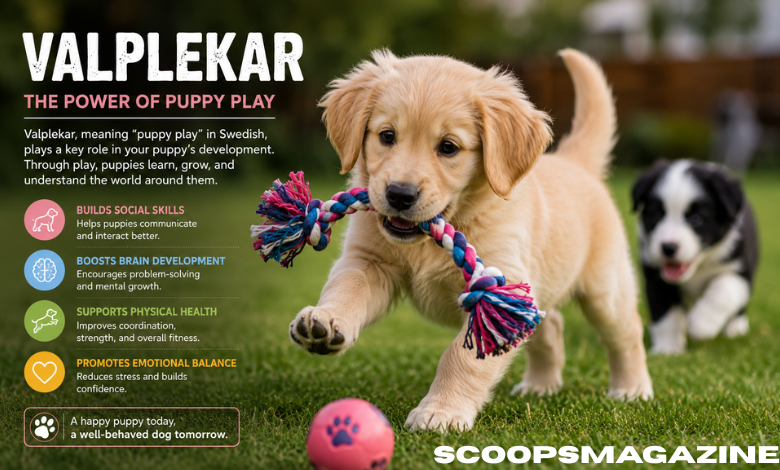
Valplekar is a Swedish term connected with puppies and play. The word combines “valp,” meaning puppy, with “lekar,” referring to games or play activities. In practical terms, valplekar describes the many ways puppies interact with people, other animals, toys, and their surroundings while growing. These activities may appear to be ordinary moments of fun, but they serve several important developmental purposes.
A young dog learns through experience rather than explanation. Running after a toy, wrestling with another puppy, investigating a new object, or trying to reach a hidden treat can all contribute to learning. Play gives puppies opportunities to practise movement, communication, self-control, and problem-solving. Understanding valplekar can therefore help owners provide activities that match a puppy’s age, energy level, and individual needs.
What Is Valplekar?
Valplekar can be understood as the collection of playful activities that form part of a puppy’s early life. It covers spontaneous games initiated by the puppy as well as planned activities introduced by an owner. These experiences may involve physical movement, interaction with other dogs, exploration, training exercises, or mentally challenging tasks.
The purpose of puppy play is not limited to entertainment. A puppy uses play to gather information about its environment and understand the consequences of different actions. For example, playing too roughly with another puppy may cause the playmate to move away or react. Such experiences gradually teach the puppy how to adjust its behaviour. In this way, play becomes an informal learning process that continues throughout early development.
Why Play Matters During Puppyhood
Puppyhood is a period of significant physical and behavioural change. Young dogs are constantly encountering unfamiliar sounds, surfaces, people, objects, and situations. Appropriate play gives them a controlled way to explore these experiences while developing important abilities.
Regular play can contribute to coordination, communication, confidence, and concentration. It can also provide a suitable outlet for natural puppy behaviours such as chasing, carrying, chewing, digging, and searching. When these needs are addressed through suitable activities, puppies have more opportunities to learn acceptable ways of using their energy.
How Puppies Learn Through Play
Puppies learn largely through repetition and consequences. During play, they try different actions and observe what happens next. A rolling ball encourages chasing, a puzzle requires investigation, and interaction with another dog demands attention to body language. Each experience provides information that the puppy can use in future situations.
This process explains why seemingly simple games can have educational value. A puppy trying to retrieve a toy is practising attention, movement, and persistence at the same time. When an owner adds simple rules, such as waiting before chasing or returning the toy, the activity can also introduce patience and cooperation.
Physical Development Through Valplekar
Movement is an important part of puppy development. Appropriate games encourage puppies to walk, run, turn, balance, and coordinate different parts of their bodies. These activities help young dogs become more comfortable and capable in their movements as they mature.
However, puppy exercise should be suited to age and physical condition. Very young dogs do not need intense workouts or repetitive activities that place unnecessary strain on developing bodies. Short play sessions, gentle exploration, and natural movement are generally more suitable than demanding exercise. Owners should also consider breed size, health, and energy levels when choosing activities.
Mental Stimulation and Problem-Solving
Not every form of valplekar requires running or chasing. Mental activities can be equally useful for puppies. Searching for treats, investigating unfamiliar objects, and working with simple food puzzles encourage puppies to think and make decisions. Mental games can be particularly helpful for puppies that remain active even after physical exercise. A dog may become tired from concentrating on a problem because thinking requires effort. Providing suitable challenges can help prevent boredom while encouraging patience, curiosity, and persistence.
The difficulty of these activities should increase gradually. If a task is impossible, the puppy may lose interest or become frustrated. A useful challenge should require some effort while still allowing the puppy to succeed.
Social Play With Other Puppies
Interaction between puppies can provide lessons that are difficult for humans to reproduce. During suitable social play, puppies chase, wrestle, pause, change roles, and respond to each other’s signals. These exchanges can help them understand communication and adjust their behaviour. Good puppy play is usually flexible. One puppy may chase for a while before becoming the one being chased. There are often pauses, changes in intensity, and opportunities for both animals to move away. Owners should supervise these interactions rather than assuming that every meeting between puppies will automatically be positive.
Size, confidence, temperament, and play style should be considered when selecting playmates. A highly energetic puppy may overwhelm a quieter dog, even without intending harm. Careful supervision helps owners recognise when play should continue and when the puppies need separation or rest.
Playing With People
Human interaction is another important part of valplekar. Games between an owner and puppy can help establish communication and make learning enjoyable. Fetch, gentle tug games, hide-and-seek, and short training activities are common examples. These games can also introduce useful household rules. A puppy can learn to release an object, wait briefly, respond to its name, or return when called. When these lessons are incorporated into enjoyable activities, training may feel less repetitive for both the puppy and the owner.
Consistency is important during interactive play. If certain behaviours are allowed one day and discouraged the next, the puppy may have difficulty understanding expectations. Clear rules make play more predictable and easier to manage.
Structured Play and Its Purpose
Structured play refers to activities that are planned or guided by the owner. The puppy is still allowed to enjoy the game, but certain rules or objectives are included. A short retrieving exercise, a simple obstacle activity, or a training game involving basic commands can all be forms of structured play. The main advantage of this approach is that enjoyment and education happen together. A puppy can practise attention, patience, and responsiveness while remaining engaged in an activity. Structured games can also help owners direct energy toward suitable behaviours.
Sessions should remain short enough to maintain interest. Puppies often have limited attention spans, particularly when they are very young. Ending an activity while the puppy is still interested may produce better results than continuing until the dog becomes distracted.
Unstructured Play and Independent Exploration
Not all puppy activities need instructions. Unstructured play gives puppies freedom to explore, investigate, and make choices independently. A puppy may move between toys, sniff around a safe area, carry objects, or invent its own games. This type of activity supports curiosity and independent thinking. Constantly directing every action can limit opportunities for a puppy to learn through personal experience. A balanced routine therefore includes both owner-guided games and safe periods of independent exploration.
The environment should still be supervised and puppy-proofed. Electrical cables, harmful plants, small objects, chemicals, and other hazards should be removed from accessible areas.
Choosing Suitable Toys for Puppy Play
Toys can make valplekar safer and more varied, but owners should choose them carefully. Suitable toys depend on the puppy’s age, size, chewing habits, and preferred style of play. Some puppies enjoy carrying soft objects, while others prefer chasing balls or working to obtain food from interactive toys. Durability and appropriate sizing are important considerations. Objects that are too small may create swallowing risks, while damaged toys can develop loose pieces. Owners should regularly inspect toys and remove those that are no longer safe.
Rotating a selection of toys can also maintain interest. A puppy does not necessarily need access to every toy at once. Temporarily storing some items and introducing them again later can make familiar objects seem interesting again.
Using Valplekar as Part of Training
Play can be incorporated into basic puppy training. Instead of relying entirely on formal exercises, owners can use games to practise everyday skills. A puppy can learn to come when called during hide-and-seek or practise releasing objects during a controlled tug game. This method can make training more engaging because the puppy receives an immediate opportunity to participate in something enjoyable. It may also help owners observe what motivates their dog. Some puppies respond strongly to food rewards, while others are more interested in toys or interaction.
Training through play should still involve clear communication. Commands should be consistent, expectations should be realistic, and progress should occur gradually.
Learning Self-Control Through Games
Young puppies are often impulsive. They may immediately chase moving objects, jump toward people, or grab whatever attracts their attention. Suitable games can help introduce basic self-control. For example, an owner can briefly ask the puppy to wait before releasing it to chase a toy. Tug games can include pauses and opportunities to practise releasing the object. These exercises teach the puppy that remaining calm for a short period does not mean the fun has ended.
Self-control develops gradually, so owners should not expect immediate results. Short, repeated experiences are often more effective than long sessions that demand more patience than the puppy can manage.
The Importance of Rest Between Play Sessions
Puppies need substantial amounts of sleep and rest. A common mistake is assuming that an active puppy always needs more exercise. In some cases, excessive excitement or difficult behaviour may occur because the puppy is tired and unable to settle. A balanced valplekar routine includes active games, mental challenges, calm interaction, and adequate rest. Owners should give puppies opportunities to sleep without frequent interruption. A quiet resting area can make it easier for the puppy to relax after activity.
Learning to settle is also an important life skill. A dog should not depend on constant entertainment from its owner throughout the day.
Signs That Play Is Becoming Too Rough
Owners should learn to recognise changes in puppy behaviour during play. Healthy interaction generally involves relaxed movements, pauses, and voluntary participation. Problems may arise when one puppy repeatedly tries to escape, hides, becomes unusually stiff, or cannot get a break from another dog. Human-puppy games can also become overly intense. Excessive biting, uncontrolled jumping, or an inability to calm down may indicate that the activity needs to stop temporarily. Rather than continuing until behaviour worsens, owners can end the session and provide time for the puppy to settle.
Understanding the difference between energetic play and uncomfortable interaction is an important part of responsible supervision.
Common Mistakes Owners Make During Puppy Play
One frequent mistake is using play only as a method of exhausting the puppy. Physical activity is important, but constant high-energy exercise does not automatically produce better behaviour. Puppies also need opportunities to think, explore, rest, and practise calmness. Another mistake is choosing activities that are too difficult. Owners may introduce complicated puzzles or expect long periods of concentration before the puppy is ready. Starting with simple tasks allows the dog to understand the activity and experience success.
Inconsistent rules can create additional confusion. If jumping, biting hands, or refusing to release toys is sometimes encouraged and sometimes punished, the puppy may struggle to understand what behaviour is expected.
Creating a Balanced Valplekar Routine
A practical puppy routine does not need to be complicated. Owners can combine several short activities across the day rather than arranging one long play period. A puppy might have a brief training game in the morning, supervised exploration later, a mental activity in the afternoon, and calm interaction in the evening. Variety is useful because different games support different abilities. Chasing and retrieving encourage movement, searching activities involve the senses, training games support communication, and independent exploration allows the puppy to make decisions.
The routine should remain flexible. Puppies differ considerably in personality, confidence, physical ability, and energy. Owners should observe their individual dog rather than following a rigid schedule.
Adjusting Play as a Puppy Grows
The type of valplekar suitable for a young puppy may change as the dog becomes older. Growing puppies often develop better coordination, longer attention spans, and stronger preferences for particular activities. Owners can gradually introduce more complex challenges as skills improve. Searching games can become more difficult, training sessions can include additional behaviours, and physical activities can change according to the dog’s development.
Regular adjustment prevents the routine from becoming repetitive. It also allows play to continue supporting the dog’s changing physical and mental needs.
Building Confidence Through Safe Experiences
Play can help puppies become more comfortable with unfamiliar situations. Exploring different safe surfaces, investigating new objects, and solving manageable problems can encourage confidence. The key is allowing the puppy to approach challenges at an appropriate pace. Forcing interaction with something frightening may increase discomfort rather than build confidence. Owners can instead provide encouragement and allow the puppy to investigate voluntarily.
Small successful experiences can gradually prepare a puppy to handle more complex situations as it matures.
How Owners Can Make Valplekar More Effective
Effective puppy play depends more on observation than expensive equipment. Owners should pay attention to which activities interest their puppy, when the dog becomes tired, and how it responds to different challenges. Games can then be adjusted according to these observations. An easily distracted puppy may benefit from shorter sessions, while a confident and curious dog may enjoy gradually increasing levels of difficulty. Puppies that become highly excited may need more frequent breaks and calmer activities.
The objective is not to keep a puppy occupied every minute. A useful approach combines interaction, learning, exploration, and rest in proportions suited to the individual dog.
Valplekar and the Development of Adult Behaviour
Experiences during puppyhood can influence habits that continue into adulthood. A puppy that regularly practises communication, appropriate social interaction, problem-solving, and self-control has opportunities to build useful behavioural skills. Play alone cannot guarantee that a dog will never develop behavioural problems. Genetics, health, environment, training, and individual experiences also matter. However, suitable play can form an important part of responsible puppy care.
Owners who view play as a learning opportunity may become better at recognising their puppy’s needs and responding appropriately.
Conclusion
Valplekar describes far more than puppies simply running around for entertainment. It includes the physical, social, mental, and interactive activities through which young dogs explore their surroundings and develop important abilities. From supervised games with other puppies to problem-solving activities and structured training exercises, different forms of play can contribute to different areas of development. A balanced approach is the most practical. Puppies need physical movement, mental stimulation, positive interaction, independent exploration, and sufficient rest. Owners should choose activities according to age, size, temperament, and individual ability rather than expecting every puppy to follow the same routine. Understanding valplekar helps owners see ordinary play from a different perspective. Every safe game, new experience, and manageable challenge can provide an opportunity for learning. By offering appropriate activities and observing how a puppy responds, owners can support the gradual development of a capable, confident, and well-adjusted adult dog.