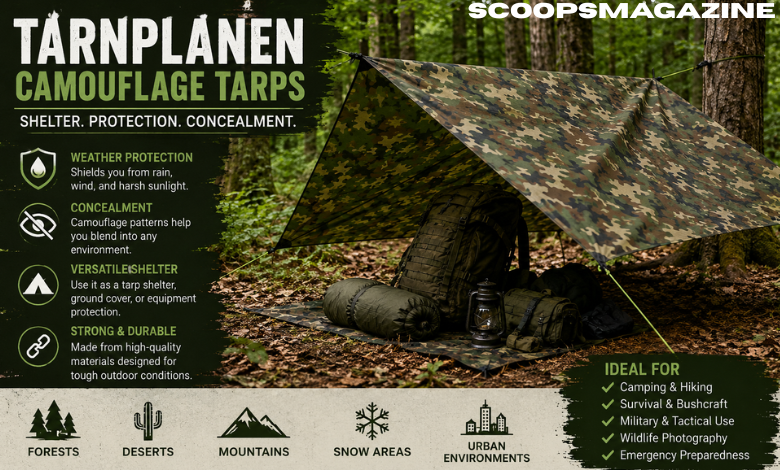
Tarnplanen refers to a type of camouflage covering made for outdoor protection, concealment, and temporary shelter. The term has German roots and is generally associated with tarps that combine weather resistance with patterns intended to reduce visibility in a surrounding environment. Instead of serving only as a cover against rain or sunlight, this type of tarp can perform several tasks depending on how and where it is used.
The concept is closely connected to military field equipment, but its use is no longer limited to armed forces. Campers, hikers, bushcraft enthusiasts, hunters, wildlife observers, and people preparing emergency kits may also use camouflage tarps. Their usefulness comes from a relatively simple design: a large piece of strong fabric that can be folded, carried, tied, stretched, or placed over equipment when needed.
What Is Tarnplanen?
Tarnplanen can be described as camouflage tarpaulins designed to provide coverage while making the covered person, shelter, or object less noticeable. The exact construction varies between products. Some are lightweight sheets intended for short trips, while others are made from thicker materials suitable for repeated exposure to difficult outdoor conditions. The camouflage pattern is one of the main features that separates Tarnplanen from ordinary tarps. Depending on the intended environment, the surface may contain combinations of green, brown, tan, grey, white, or black. These patterns break up large visible shapes and help the material appear less distinct against trees, vegetation, soil, rocks, snow, or other surroundings.
Protection remains equally important. A well-made camouflage tarp may provide coverage from rainfall, direct sunlight, wind, moisture, and dirt. For this reason, people often choose it when they want one item that can perform several outdoor functions.
The Basic Purpose Behind Tarnplanen
The main idea behind Tarnplanen is practical versatility. Carrying separate equipment for shelter, ground protection, equipment coverage, and visual concealment can add considerable weight to outdoor gear. A single tarp can potentially handle several of these jobs. For example, a camper can stretch the material between trees to create overhead protection. Later, the same tarp can be placed beneath camping equipment to keep it away from wet ground. It can also cover supplies during unexpected rain. When packed properly, many modern versions take up relatively little space.
This flexibility explains why camouflage tarps continue to be used despite the availability of tents and other specialized shelters. They provide fewer built-in features than a tent, but their open design allows users to adapt them to changing situations.
How Tarnplanen Differs From an Ordinary Tarp
At first glance, a camouflage tarp and a standard utility tarp may appear nearly identical. Both are sheets of material designed to cover, protect, or create temporary shelter. The differences become clearer when examining their intended applications. Ordinary tarps are commonly produced in bright blue, green, silver, or other solid colors. They are frequently used for construction projects, gardening, transportation, storage, and household maintenance. Visibility is usually not an important concern.
Tarnplanen, in contrast, places greater emphasis on blending with a particular environment. The surface design is selected to reduce visual contrast. Some versions are also manufactured for frequent folding, outdoor transportation, and repeated setup. However, camouflage does not automatically mean better quality. A standard tarp made from strong material can be more durable than a poorly manufactured camouflage model. Buyers should therefore examine fabric, stitching, waterproofing, attachment points, and overall construction rather than judging a product only by its pattern.
The Historical Development of Camouflage Tarps
The development of Tarnplanen is connected to the wider history of military camouflage. As observation methods and military technology changed, concealment became increasingly important. Soldiers, vehicles, supplies, and temporary positions needed protection from visual detection. Early camouflage techniques often relied on natural vegetation, paint, fabric, and improvised coverings. Over time, military organizations began developing standardized camouflage equipment designed for specific environments.
Patterned sheets and shelter materials became useful because they could serve more than one purpose. A soldier could carry a piece of fabric that worked as a rain cover, shelter component, equipment covering, or concealment aid. Modern camouflage tarps have developed far beyond these earlier designs. Manufacturers can now produce lightweight synthetic fabrics, waterproof coatings, reinforced edges, and compact materials that are easier to transport. Civilian outdoor users have adopted many of these practical features.
Common Materials Used in Tarnplanen
The performance of Tarnplanen depends heavily on the material used in its construction. Different fabrics provide different levels of weight, strength, water resistance, and portability. Ripstop nylon is frequently chosen for lightweight outdoor equipment. Its woven construction is designed to limit the spread of small tears. This can be useful in forests and other environments where branches and rough surfaces may damage fabric. Nylon tarps are often compact, making them suitable for people concerned about backpack weight.
Polyester is another common option. It generally maintains its shape well and can provide reliable performance during regular outdoor use. Many affordable camping tarps are manufactured from polyester combined with a water-resistant coating. Canvas offers a different experience. It is heavier and bulkier than most synthetic materials but can provide strong physical protection and long-term durability. Canvas may be selected for semi-permanent camps, work areas, or situations where low carrying weight is not the main concern. Some heavy-duty tarps use PVC-coated material. These coverings can provide strong resistance to water and rough weather but are generally heavier and less convenient for long-distance hiking.
Camouflage Patterns and Environmental Conditions
Not every camouflage design works equally well in every location. A pattern created for dense woodland may stand out in an open desert, while a white winter covering would be highly visible in a green forest. Woodland patterns commonly use shades of green, brown, and black. They are designed for areas containing trees, leaves, vegetation, and shadow. Desert designs rely more heavily on tan, beige, and light brown. These colors can better match dry soil, sand, and rocky landscapes.
Winter camouflage often contains white, grey, and muted dark markings. Its purpose is to reduce contrast in snowy or partially snow-covered areas. Some Tarnplanen products use neutral patterns that are intended for mixed terrain. They may not provide highly specialized concealment, but they can be more practical for people who regularly visit different environments. Selecting a pattern should therefore depend on actual use rather than appearance alone.
Tarnplanen as a Temporary Outdoor Shelter
Shelter construction is one of the most common civilian uses of a camouflage tarp. With rope, cord, poles, or nearby trees, a tarp can be arranged in several configurations. An A-frame setup is created by running a line between two support points and placing the tarp over it. The sides are then secured near the ground. This arrangement provides basic protection from rain and can create a sleeping area beneath the covering.
A lean-to configuration keeps one side raised while the opposite edge is secured closer to the ground. It offers ventilation and an open view but provides less protection from wind coming from the exposed direction. A low-profile setup positions the tarp closer to the ground. This can reduce exposure to strong wind and create a smaller shelter area. The best arrangement depends on weather, terrain, available attachment points, and the number of people using the shelter.
Camping and Bushcraft Applications
Campers often value equipment that can perform multiple functions, and Tarnplanen fits this requirement. It can create a covered cooking area, protect backpacks, provide shade, or serve as an additional layer beneath a tent. Bushcraft users may rely on tarps because they allow greater flexibility than fixed shelters. Instead of carrying a complete tent structure, the user can adapt the covering to trees, poles, rocks, and other features of the surrounding landscape.
The open design can also improve ventilation. During warm weather, a raised tarp may provide shade and rain protection without trapping as much heat as an enclosed tent. The disadvantage is that proper setup requires practice. Wind direction, water drainage, rope tension, and ground conditions all influence whether the shelter performs effectively.
Use in Emergency Preparedness
A camouflage tarp can also have a place in emergency supplies. Natural disasters, vehicle problems, damaged buildings, and unexpected travel disruptions can create situations where temporary protection is needed. A tarp can cover broken windows, protect supplies from rainfall, provide shade, create a temporary sleeping area, or separate belongings from wet ground. Its simple construction means it can be adapted without complicated equipment.
For emergency preparation, camouflage is not always necessary. In some situations, a brightly colored tarp may actually be preferable because it improves visibility for rescuers. The decision should depend on the intended emergency plan. People building preparedness kits should therefore consider the tarp primarily as a protective and shelter item rather than assuming concealment is always beneficial.
Wildlife Observation and Photography
Wildlife photographers and observers often need to remain quiet and visually unobtrusive. Tarnplanen can help create a temporary observation position by covering equipment or forming a basic screen. Animals can react to unfamiliar movement and large contrasting shapes. A camouflage covering may reduce the visual impact of cameras, tripods, bags, and the observer’s outline.
However, the tarp alone does not make a person invisible to wildlife. Movement, noise, wind direction, and scent can still affect animal behavior. Responsible observation also requires maintaining suitable distance and avoiding unnecessary disturbance. For photographers, a lightweight tarp can be useful because it can be carried to different locations without requiring a permanent hide.
Protecting Outdoor Equipment
Not every use of Tarnplanen involves sheltering people. Equipment protection is another practical application. Bicycles, firewood, tools, camping supplies, backpacks, and other objects may need temporary coverage from rain, dust, sunlight, or falling debris. A tarp can be placed directly over the items and secured using cords or straps.
Proper airflow should still be considered. Completely wrapping damp equipment for a long period can trap moisture and contribute to unpleasant odors, corrosion, or material damage. For longer storage periods, the tarp should be positioned in a way that prevents water accumulation and allows some ventilation where appropriate.
Important Features to Consider
Choosing suitable Tarnplanen requires more than selecting a preferred camouflage pattern. Size is one of the first considerations. A small tarp is easier to transport but provides limited coverage. Larger models create more shelter space but add weight and require additional room for setup. Attachment points are equally important. Reinforced loops, tabs, or eyelets allow the tarp to be secured to trees, poles, stakes, and ropes. Weak attachment areas may tear when placed under tension.
Water resistance should be examined carefully. Some materials are fully waterproof, while others only resist light moisture. Seam construction and coatings can also affect performance during prolonged rain. Weight and packed size matter most for hikers and backpackers. Car campers and people using fixed outdoor locations may prefer heavier materials because portability is less important.
Proper Setup and Handling
Correct use can extend the life of a camouflage tarp. Excessive tension should be avoided because it can damage attachment points or fabric during strong winds. The tarp should normally be angled so that rainwater runs off instead of collecting in the center. Standing water adds weight and may stretch or damage the material.
Sharp branches and rough rocks should be removed from direct contact areas whenever possible. Small abrasions can eventually develop into larger holes. Users should also inspect ropes and stakes during changing weather conditions. Ground that was firm during setup may become soft after heavy rain, causing stakes to loosen.
Cleaning and Maintenance
Regular maintenance helps Tarnplanen remain useful for longer periods. After outdoor use, loose soil, leaves, and other debris should be removed before storage. If washing is necessary, the manufacturer’s care instructions should be followed. Strong cleaning chemicals can damage waterproof coatings on some synthetic fabrics.
One of the most important steps is complete drying. Folding and storing a wet tarp can encourage mildew, odors, and material deterioration. Small holes should be repaired before they become larger. Repair tape, patches, or suitable fabric treatments can often handle minor damage. Attachment points should also be checked for loose stitching and early signs of tearing.
Limitations of Tarnplanen
Despite its versatility, Tarnplanen is not the correct solution for every outdoor situation. A tarp usually provides less protection from insects than an enclosed tent. It may also offer limited privacy and reduced insulation during cold weather. Setting up a stable shelter can be difficult in places without trees, poles, or suitable anchor points. Strong wind can also create challenges if the tarp is poorly positioned.
Camouflage patterns may be unsuitable during emergencies when being easily located is important. People should understand these limitations rather than treating a camouflage tarp as a complete replacement for all other outdoor equipment.
Choosing Tarnplanen for the Intended Purpose
The right choice depends on how frequently the tarp will be used and under what conditions. A backpacker may prioritize low weight and compact storage. A photographer may focus more on camouflage pattern and quiet fabric. Someone preparing equipment for a fixed campsite may prefer thicker and more durable material. Climate also matters. Frequent rainfall increases the importance of waterproof construction, while strong sunlight may require better resistance to ultraviolet exposure.
Before purchasing or using Tarnplanen, it is useful to identify the main purpose first. This prevents paying for unnecessary features or selecting a product that performs poorly under actual conditions.
The Continued Practical Value of Camouflage Tarps
The basic design of Tarnplanen remains relevant because it solves several outdoor problems without requiring complicated technology. A single sheet of suitable material can provide shelter, shade, equipment protection, ground coverage, and visual concealment. Modern manufacturing has improved portability and weather resistance, but the fundamental principle has changed very little. The usefulness of a tarp still depends largely on material quality, correct setup, maintenance, and the ability of the user to adapt it to different situations. This simplicity is one reason camouflage tarps continue to appear in camping equipment, emergency supplies, military applications, photography gear, and bushcraft kits.
Conclusion
Tarnplanen is a camouflage tarp designed to combine outdoor protection with reduced visual visibility. Although its background is closely associated with military camouflage equipment, its applications now extend to camping, bushcraft, wildlife observation, emergency preparation, and general equipment protection. Different materials, sizes, patterns, and construction methods make some models better suited to particular conditions than others. Lightweight synthetic fabrics may be practical for hiking, while heavier materials can provide greater durability for long-term outdoor use. The main value of Tarnplanen comes from adaptability. It can become a temporary shelter, rain cover, groundsheet, shade structure, observation screen, or protective covering depending on the situation. Understanding its strengths and limitations allows users to select and use it more effectively.