Many people shopping for an electric SUV ask the same question: do the driving modes in Cadillac Lyriq offer different ranges or battery usages? It is a reasonable question because driving modes promise different performance characteristics, and many drivers want to know whether changing a setting can help them travel farther before recharging.
The simple answer is yes, but the change is not as dramatic as some people expect. Driving modes do not increase the battery’s physical capacity. Instead, they adjust how the vehicle delivers power, responds to accelerator input, controls regenerative braking, and manages various systems. These adjustments can influence energy consumption and, over time, affect the total distance you can travel on a charge.
What Does “Do the Driving Modes in Cadillac Lyriq Offer Different Ranges or Battery Usages?” Mean?
The question refers to whether selecting a different driving mode changes the amount of electricity the Cadillac Lyriq consumes while driving.
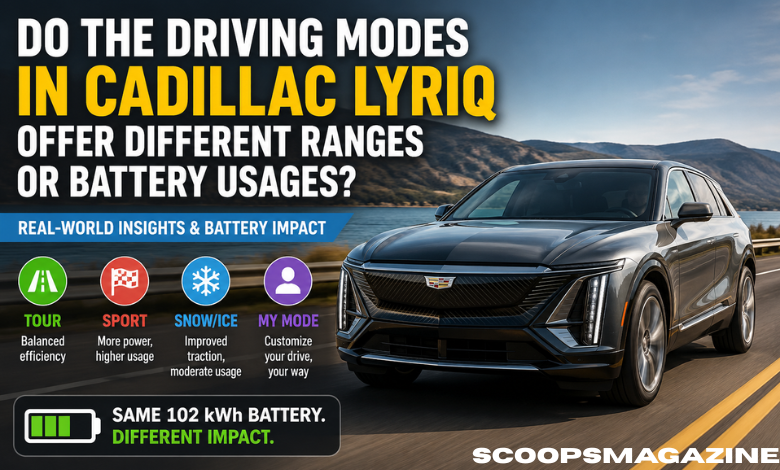
Every Lyriq uses the same battery pack regardless of the selected mode. Switching from Tour to Sport does not add extra battery capacity or remove any stored energy. What changes is the vehicle’s behavior. The software tells the electric motors how aggressively to deliver power and how efficiently to recover energy during deceleration.
As a result, some driving modes encourage efficient driving while others prioritize quicker acceleration and a more responsive feel.
Understanding the Cadillac Lyriq Battery System
Before discussing driving modes, it helps to understand how the battery works.
The Cadillac Lyriq is equipped with a large high-voltage lithium-ion battery designed to power the electric motors over long distances. The battery stores electrical energy, while sophisticated software continuously determines how that energy is delivered based on driver inputs and road conditions.
The battery management system also protects the battery from excessive temperatures, monitors charging, balances individual battery cells, and ensures consistent performance throughout daily driving.
Why Cadillac Includes Multiple Driving Modes
Driving conditions are never identical. A busy city commute requires different vehicle behavior than a long highway trip or a winding country road.
Instead of forcing every driver to use identical settings, Cadillac allows owners to select driving modes that change the vehicle’s response.
These modes mainly adjust:
- Accelerator sensitivity
- Steering feel
- Power delivery
- Regenerative braking characteristics
- Overall driving response
Because these systems influence energy consumption, battery usage naturally changes as well.
Tour Mode: Designed for Everyday Efficiency
Tour Mode is intended for daily driving and is the setting many owners leave selected most of the time.
Acceleration remains smooth and predictable without feeling sluggish. The accelerator pedal responds naturally, making it easier to maintain steady speeds in city traffic and on highways.
Since sudden acceleration is reduced, energy consumption generally remains lower than in more aggressive modes. Consistent driving also allows regenerative braking to recover energy more effectively.
For drivers focused on getting the most distance from each charge, Tour Mode usually provides the best balance between comfort and efficiency.
Sport Mode: Faster Response with Higher Energy Use
Sport Mode changes the vehicle’s personality.
The accelerator reacts more quickly, allowing the electric motors to deliver higher power almost immediately after the driver presses the pedal. Steering may also feel firmer, giving the SUV a more responsive character.
Although this creates a more engaging driving experience, it often increases battery usage.
Rapid acceleration requires significantly more electrical energy than gradual acceleration. Even though regenerative braking helps recover some power, it cannot completely offset the extra energy consumed during repeated hard acceleration.
Drivers who regularly use Sport Mode may notice their estimated driving range decreases more quickly than when driving in Tour Mode.
Snow and Ice Mode Prioritizes Stability
Snow and Ice Mode is not designed to improve range. Instead, it helps maintain traction on slippery roads.
The system softens accelerator response, allowing smoother starts that reduce wheel spin. Power delivery becomes more gradual, helping the tires maintain grip on snow, ice, or wet pavement.
Interestingly, the softer throttle response may slightly improve efficiency during careful winter driving. However, cold weather itself reduces battery efficiency, so any energy savings from the driving mode are often outweighed by lower battery performance and increased heating demands.
My Mode Lets Drivers Customize Performance
Cadillac also provides a customizable driving option that allows drivers to combine different settings according to personal preference.
Instead of accepting factory presets, owners can choose how responsive they want the steering and acceleration to feel.
This flexibility allows drivers to create a setup that matches their driving habits. Someone who prefers lighter steering but moderate acceleration can build a profile that feels comfortable without unnecessarily increasing battery consumption.
Battery usage depends entirely on the selected settings and driving style rather than the existence of the custom mode itself.
How Driving Modes Influence Battery Usage
Driving modes affect battery usage by changing how easily electrical power is delivered to the motors.
A more aggressive accelerator map encourages quicker acceleration, requiring larger bursts of electricity from the battery. A calmer accelerator map encourages gradual acceleration, reducing peak energy demand.
This difference becomes noticeable during everyday driving because acceleration is one of the largest consumers of battery power in any electric vehicle.
The harder the motors work, the faster stored energy is consumed.
The Importance of Regenerative Braking
One major advantage of electric vehicles is regenerative braking.
Instead of wasting energy as heat during braking, the electric motors temporarily operate as generators. This converts part of the vehicle’s motion back into electricity and returns it to the battery.
Driving modes can influence how regenerative braking feels.
Some settings encourage stronger energy recovery when the driver lifts off the accelerator, while others allow the vehicle to coast more freely.
Although regenerative braking improves efficiency, it does not create free energy. It simply recovers a portion of energy that would otherwise be lost.
Driving Style Has a Bigger Impact Than Driving Mode
Many people assume changing driving modes automatically changes vehicle range dramatically.
In reality, driver behavior has a much larger influence.
Two people using the same driving mode may experience completely different battery usage because of differences in acceleration, cruising speed, braking habits, and route selection.
A gentle driver using Sport Mode may achieve better efficiency than an aggressive driver using Tour Mode.
Driving mode only changes the vehicle’s responses. The driver ultimately decides how much energy is consumed.
Highway Driving Versus City Driving
Driving environment also affects battery usage.
In city traffic, regenerative braking frequently recovers energy because drivers regularly slow down for traffic lights, intersections, and congestion.
On highways, opportunities for regeneration become much less frequent.
Higher sustained speeds also increase aerodynamic resistance, requiring more energy to maintain cruising speed regardless of the selected driving mode.
Because of this, highway range differences between Tour and Sport Mode often become more noticeable during long trips.
Does Driving Mode Change Battery Capacity?
No.
This is one of the most common misunderstandings among new EV owners.
The Cadillac Lyriq battery stores the same amount of electricity regardless of which driving mode is selected.
Changing modes does not unlock hidden battery capacity or reduce available energy.
Only the vehicle’s software behavior changes.
The battery itself remains exactly the same.
How Climate Control Affects Range
Drivers often blame driving modes when they notice lower range, but climate control frequently has a larger impact.
Heating the cabin during winter or cooling it during very hot weather requires electricity directly from the battery.
Seat heaters, steering wheel heaters, windshield defrosters, and air conditioning all increase overall energy consumption.
Even if Tour Mode is selected, heavy climate control use can noticeably reduce available driving range.
Tire Pressure Also Influences Efficiency
Proper tire pressure plays an important role in battery usage.
Underinflated tires increase rolling resistance, forcing the electric motors to work harder.
Correct tire pressure allows the vehicle to roll more efficiently and helps maximize available range.
This improvement occurs regardless of the selected driving mode.
Vehicle Weight Changes Energy Consumption
Additional cargo increases battery usage.
Carrying heavy luggage, transporting equipment, or towing where permitted requires additional energy for acceleration and climbing hills.
Driving modes cannot eliminate the effects of extra weight.
A lightly loaded Lyriq generally travels farther on a charge than one carrying several passengers and heavy cargo.
Outside Temperature Matters
Battery performance naturally changes with temperature.
Cold weather slows chemical reactions inside lithium-ion batteries, reducing available efficiency.
Hot weather may activate battery cooling systems, which also consume electricity.
Drivers sometimes believe a driving mode caused lower range when seasonal temperatures are actually responsible.
Can Driving Modes Add Significant Range?
Driving modes alone rarely produce dramatic differences.
Instead, they contribute to overall efficiency alongside many other factors including:
- Driving habits
- Average speed
- Weather
- Road conditions
- Tire condition
- Traffic
- Climate control usage
When combined with efficient driving techniques, selecting the appropriate driving mode can help preserve battery energy over long trips.
Best Driving Mode for Maximum Range
For drivers whose primary goal is maximizing driving distance, Tour Mode generally offers the most balanced setup.
It encourages smooth acceleration without making the vehicle feel slow. Combined with moderate highway speeds, proper tire maintenance, and intelligent climate control use, Tour Mode helps many owners achieve consistent efficiency.
However, maintaining steady speeds and avoiding unnecessary rapid acceleration remains more important than the selected mode itself.
Best Driving Mode for Performance
Drivers who enjoy quicker acceleration and a more immediate response often prefer Sport Mode.
The vehicle feels more responsive, especially during merging, passing, or spirited driving.
The trade-off is higher electricity consumption.
Most drivers accept this reduction because the improved responsiveness better matches their driving preferences.
Should You Change Modes Frequently?
Yes, changing modes whenever driving conditions change is perfectly acceptable.
Owners may use:
- Tour Mode for commuting
- Sport Mode on open roads
- Snow and Ice Mode during winter weather
- My Mode for personalized settings
Switching between modes does not damage the battery or reduce battery life.
The vehicle is designed for regular mode changes.
Common Misconceptions About Driving Modes
Several myths continue to circulate among EV owners. One misconception is that Sport Mode permanently damages battery health. In reality, the battery management system carefully controls power delivery to protect the battery. Another misconception is that Tour Mode always guarantees maximum range. While it encourages efficient driving, poor driving habits can still produce high battery usage. Some also believe regenerative braking completely replaces charging. Although regeneration recovers useful energy, it only restores a portion of energy already used during driving.
Tips to Reduce Battery Usage
Owners who want the best possible efficiency should focus on practical driving habits rather than relying entirely on driving modes.
Helpful habits include:
- Accelerate gradually whenever possible.
- Maintain steady cruising speeds.
- Anticipate traffic to reduce unnecessary braking.
- Keep tires properly inflated.
- Remove unnecessary cargo.
- Use climate control efficiently.
- Take advantage of regenerative braking.
- Choose Tour Mode for routine driving.
These habits usually provide greater energy savings than simply switching between driving modes.
Final Thoughts
So, do the driving modes in Cadillac Lyriq offer different ranges or battery usages? The answer is yes, but indirectly. Driving modes do not change the battery’s size or capacity. Instead, they influence how efficiently stored electricity is used by adjusting acceleration, power delivery, steering characteristics, and regenerative braking behavior. For most drivers, Tour Mode provides the best balance between efficiency and comfort, making it a practical choice for everyday travel. Sport Mode delivers quicker responses and stronger acceleration but typically consumes more battery energy. Snow and Ice Mode improves traction in challenging weather, while My Mode allows drivers to personalize the experience.
The biggest factor affecting driving range is still the person behind the wheel. Smooth acceleration, moderate speeds, efficient braking, proper tire maintenance, and sensible climate control usage have a greater impact on battery consumption than driving mode alone. Understanding how these systems work together allows Cadillac Lyriq owners to choose the most suitable mode for every journey while making the most of each battery charge.